The Dynasties of the Kings of France in your Living Room
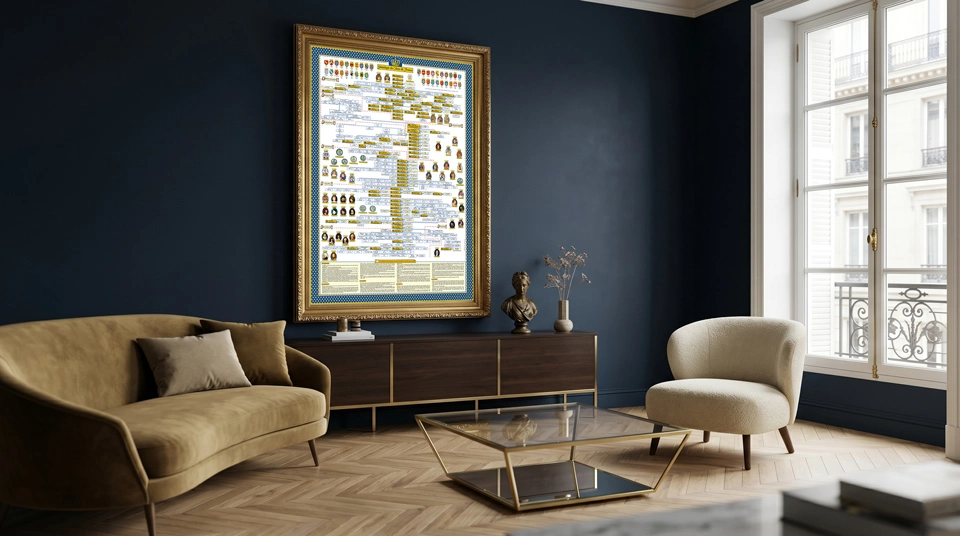
Understanding the history of France means above all diving into the fascinating meanders of its dynasties. From the Merovingians to the Bourbons, more than 1400 years of reigns have followed one another, forging the borders, institutions and culture of our country. But how do you find your way through the complex alliances, fraternal betrayals, Salic laws and collateral royal branches ?
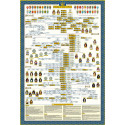
It is to meet this exciting challenge that DYNASTY has designed the complete genealogy of the Kings of France, available on https://www.roisdefrance.info/gb/module/dgtranslationall/urlstranslation. In this in-depth article, let's decipher the evolution of royal power and see how to transform academic knowledge into a major artistic fresco at the heart of your living space.
1. The challenge of historical clarity: 14 centuries of epic
The history of the French monarchy is often taught in a linear way, masking the reality of ruptures and dynastic continuities. Of the accession of Clovis in 428 until the fall of Louis-Philippe in 1848, France has known three great races of kings, subdivided into many branches (Valois, Bourbons, Orléans). For the history buff as well as for the researcher, visualizing the concomitance of events and blood ties is sometimes a headache.
A classic family tree often just lines up names and dates. A real Historical fresco, on the other hand, contextualizes each sovereign within his or her rightful lineage, highlighting the succession crises that reshaped Europe. It is this ambition for total clarity, validated by in-depth research, that makes the project unique Dynastie.
Did you know? Capetian continuity > Despite the changes in the names of the branches (Valois, Bourbons), all the kings of France from Hugues Capet (987) to the last king of the French Louis-Philippe belong to the same agnatic lineage: the Capetians. It is a biological and political stability unique in world history.
In genealogy, this is called the agnatic lineage (the transmission from father to son). Whether they are called Capet, Valois, or Bourbon, they are all descended, through men, from the same common ancestor.
Here is how these branches relate to the main family tree:
-
- The direct Capetians (987 - 1328): From Hugues Capet to Charles IV. The direct line stopped because the last kings had no sons to succeed them.
- The Valois (1328 - 1589): When the direct branch dies out, the nearest cousin is sought by humans. It is Philippe de Valois. His grandfather was King Philip III the Bold. He is therefore indeed a Capetian.
- The Bourbons (1589 - 1848): When Henry III (the last Valois) died, the closest male relative was Henry of Navarre, who became Henry IV. His direct ancestor in the male line was Robert de Clermont, the youngest son of the king... Saint Louis (a direct Capetian) !
That's why during the French Revolution, when Louis XVI was stripped of his titles, he was officially renamed "Citizen Louis Capet". Even after centuries of separation into different branches, his fundamental surname remained Capet.
This unique continuity can be explained by the Salic Law, which strictly forbade women from ruling or passing on the right to rule. The throne could therefore never pass to another family by marriage (unlike in England, where dynasties have often changed: Plantagenet, Tudor, Stuart, Windsor...).
2. Why does the historical fresco find its place in our interiors ?
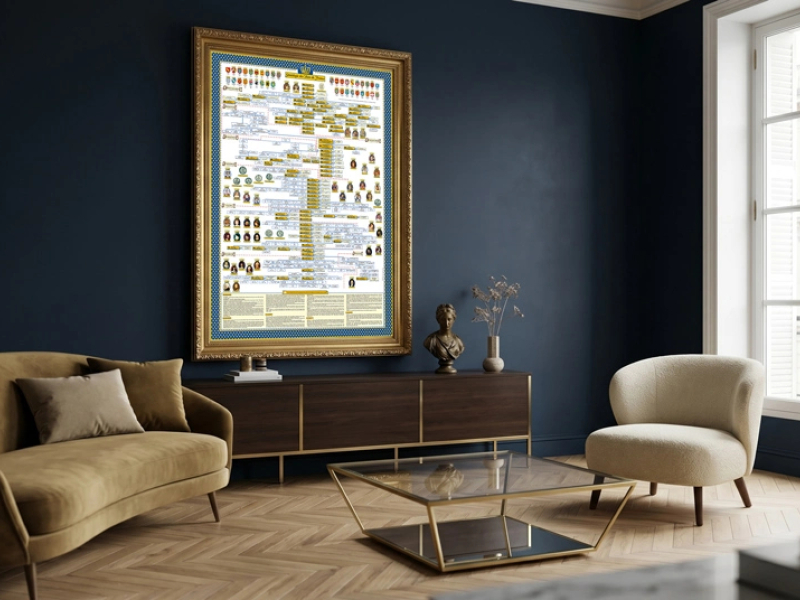
Beyond purely scholarly interest, history is now making a spectacular contribution to interior design. The return of the "heritage" or "elegant maximalist" style testifies to a need to reconnect with the long term and meaningful objects. It is proudly displayed in a living room, library or office.
The alliance of rigour and aesthetics
The main pitfall of historical documents often lies in their austere or exaggerated aesthetics. The choice of Dynastie was to conceive a sleek design, where graphic minimalism serves readability. Each transmission line, each sovereign cartouche has been designed to fit harmoniously into a contemporary or classic setting.
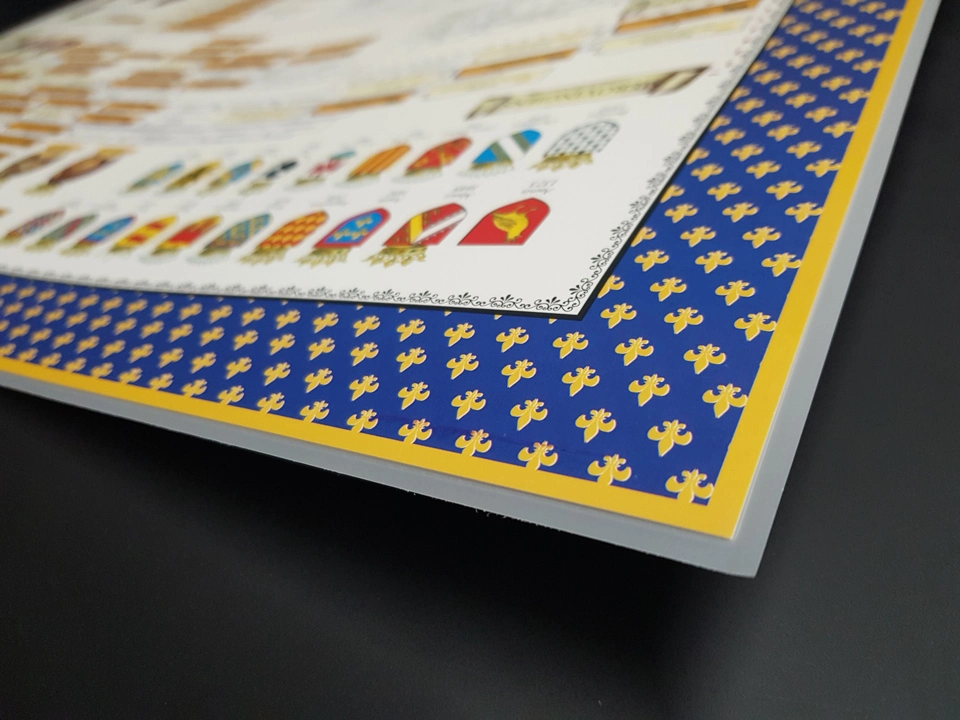
Exceptional support: The choice of high-quality paper
For such a document to survive the years and become an object of family transmission, material quality is essential. The printing is carried out on a High quality paper, with a heavy weight, offering remarkable durability. This choice guarantees faithful colour reproduction, perfect sharpness of the finest writings and optimum lightfastness. The great houses of France are thus displayed with the prestige they deserve.
3. A unique educational tool for the whole family
How many table discussions are animated around a historical question? "Who was the successor of Saint Louis?" "What is the exact link between Louis XIV and Louis XVI?" Having this large mural within sight turns learning history into a spontaneous everyday game.
For children and students, visual memory is a powerful learning lever. Visualize the length of a reign (such as 72 years old of Louis XIV) in relation to others, or to understand immediately how the Crown passed from the direct Capetians to the Valois after the crisis of 1328, makes matter alive and concrete.
4. How-to Guide: How to Read and Interpret the Mural Dynastie
To get the most out of your poster, here are the essential keys to share with your loved ones:
- The chronological axis (vertical/horizontal): It allows you to follow the passage of the centuries, from medieval origins to modernity, offering an immediate overview.
- The branches: They help to spot major transitions instantly. The direct Valois, the Valois-Orléans, or the Bourbons have distinctive markers that make it possible to isolate each era.
Strategic alliances: The connecting lines materialize the marriages that often sealed the fate of entire provinces (such as the annexation of Brittany via Anne of Brittany).
Embrace your royal touch today
Don't leave the history of France confined to textbooks. Give your home an art object that inspires admiration, stimulates the intellect and celebrates our shared heritage. Go to https://www.roisdefrance.info/gb/module/dgtranslationall/urlstranslation To discover the fresco and order your copy printed on our exceptional art paper.
Share this content