The Merovingians
- 1. Who were the Merovingians? The origins of the myth
- 2. The meteoric rise of Clovis I: The founder
- 3. The Baptism of Reims: The birth certificate of the Christian monarchy
- 4. The division of the kingdom and the Salic law: A precarious stability
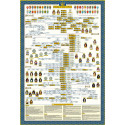
- 5. How to read the Merovingian family tree on our poster?
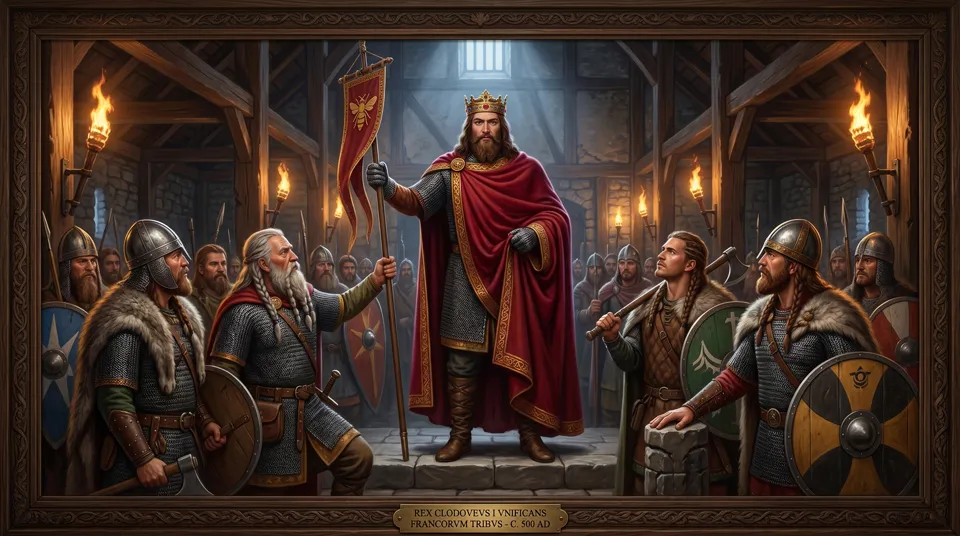
To understand the birth of France, it is inevitable to turn to the very first great lineage that shaped our territory: the Merovingian dynasty. More than 1500 years separate us from this founding era, when scattered tribes were unified under the grip of a single chief. It all starts with Clovis, the first great king! 👑
But did you really know how this sovereign unified these peoples to lay the foundations of the French nation? From epic battles to strategic alliances, the Merovingians laid the foundation stones of our culture.
In this complete article, we propose to retrace the epic of this fascinating dynasty. We will dive into the heart of the first dynastic bloodlines to unravel the myths of history and give you the keys to understanding this period. Finally, we will decipher how to read and understand the evolution of these sovereigns thanks to our detailed family tree of the Kings of France : a real visual journey certified by historians!
1. Who were the Merovingians? The origins of the myth
The Merovingian dynasty takes its name from Merovea, a legendary leader of the Salian Franks who is said to have fought alongside the Romans in the Battle of the Catalaunian Fields in 451. Although Merovea's historical existence remains shrouded in mystery, it was his grandson, Clovis I, who transformed this small Germanic people settled in northern Gaul into a major power in medieval Europe.
Contrary to the caricatural image of "lazy kings" propagated much later by Carolingian propaganda, the early Merovingian period was a period of political turmoil, of cultural mixing between Roman and Germanic traditions, and of major territorial expansion.

2. The meteoric rise of Clovis I: The founder
When Clovis acceded to the throne in 481, the landscape of ancient Roman Gaul was totally fragmented. Between the kingdom of Syagrius (the last remnant of the Roman Empire), the Visigoths in the south, and the Burgundians in the east, the Salian Franks occupied only a small territorial portion.
With an exceptional tactical sense, Clovis breaks these locks one by one:
-
The Battle of Soissons (486): He defeated Syagrius and annexed his lands, extending his influence to the Loire.
-
The Burgundian alliance: He married Clotilde, a Burgundian princess of Christian faith, who played a crucial role in the king's religious choices.
-
The Battle of Tolbiac (496): Against the Alemanni, Clovis invokes the "God of Clotilde" and promises to convert if he wins. It was a resounding success.
3. The Baptism of Reims: The birth certificate of the Christian monarchy
It was between 496 and 508 (the exact date still divides historians) that Clovis, accompanied by 3000 of his warriors, was baptized in Reims by Bishop Remi.
This event is fundamental for two reasons. Politically, he enabled Clovis to secure the unwavering support of the local Gallo-Roman populations and the bishops, who held immense administrative influence. Religiously, this established a sacred tradition: Reims became the city of coronations, a common thread that would unite the kings of France for more than a millennium.
In 507, with this legitimacy, Clovis crushed the Visigoths at the Battle of Vouillé, pushing the borders of his kingdom as far as the Pyrenees. A fine strategist, he then chose Paris as the official capital of his kingdom, building the Abbey of the Holy Apostles (the future Abbey of Sainte-Geneviève).
4. The division of the kingdom and the Salic law: A precarious stability
On the death of Clovis in 511, the kingdom was divided between his four sons (Thibert, Childebert, Clodomir and Clotaire), following the Germanic tradition which considered the kingdom to be a private patrimony of the king. This successive system of division would generate centuries of fratricidal wars between different regional capitals (Metz, Soissons, Paris, Orléans), illustrated by the legendary conflicts between the queens Frédégonde and Brunehaut.
It was also during the reign of Clovis that the Salic Law was drafted. Originally a code of criminal and civil laws to regulate conflicts, it was reinterpreted centuries later (under the Capetians) to prohibit women from accessing the throne of France.


5. How to read the Merovingian family tree on our poster?
The complexity of the Merovingian period lies in the repetition of first names (the countless Clotaire, Dagobert or Chilpéric) and the incessant sharing of the territory. It is precisely to make this history clear and accessible that DYNASTIE has designed its poster of the family tree of the Kings of France.
At the top of our historical fresco, you will discover the Merovingian section, structured in such a way that you can:
-
Visualize filiations at a glance: Follow the direct line from Clovis I to Childeric III, the last Merovingian king deposed in 751.
-
Understanding the periods of unification: Easily spot the rare moments when the kingdom was completely reunified under one man, such as during the reigns of Clotaire I, Clotaire II or the famous King Dagobert I.
-
Validated authenticity: Every name, reign date, and alliance has been scrupulously vetted by historians to ensure you have a reliable learning tool, ideal for family transmission or to decorate your home with a touch of royal history.
Don't let the complexity of dynasties intimidate you anymore. Make the history of France a captivating visual journey to the heart of your home by discovering our complete poster on roisdefrance.info.
Share this content