The Capetian Miracle: 300 years of uninterrupted lineage have forged France
- 1. 987: The accession of Hugh Capet and the end of instability
- 2. The "Early Coronation": A formidable political strategy
- 3. From Philip Augustus to Saint Louis: The Apogee of the Direct Capetians
- 4. 1316: The End of an Era and the Succession Crisis
- How to find one's way around and read the family tree of these dynasties?
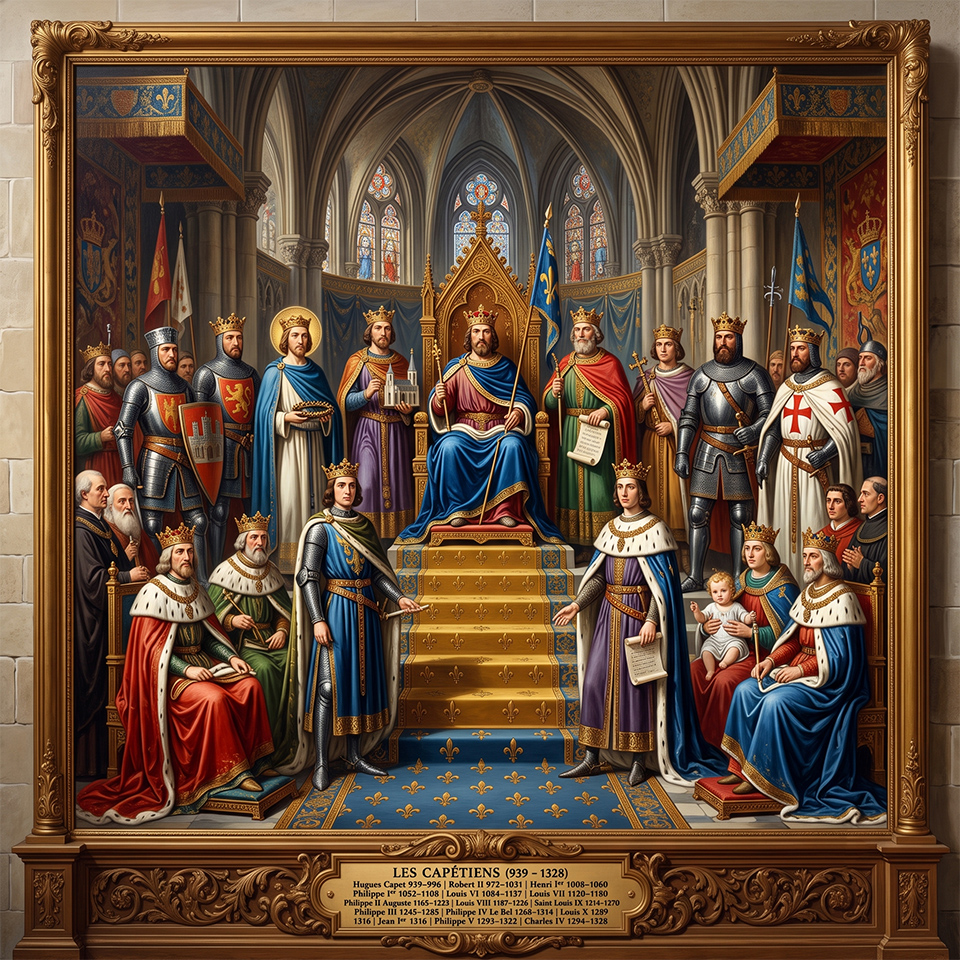
Behind the borders and culture of today's France lies the fascinating saga of its great dynasties. If the Merovingians and the Bourbons frame more than 1400 years of reign that have shaped our country, one lineage particularly fascinates by its extraordinary stability: the direct Capetians. How, from the election of Hugh Capet in 987 to the death of John I the Posthumous in 1316, could the crown be transmitted from father to son without the slightest rupture?
For three centuries, an incredible alignment between a lenient biological destiny and an implacable political strategy gave birth to the famous "Capetian Miracle". Dive with us into the heart of this adventure to discover how these rulers turned a fragmented territory into a major European power, and learn how to retrace this epic with the exclusive family tree of the Kings of France imagined by DYNASTIE.
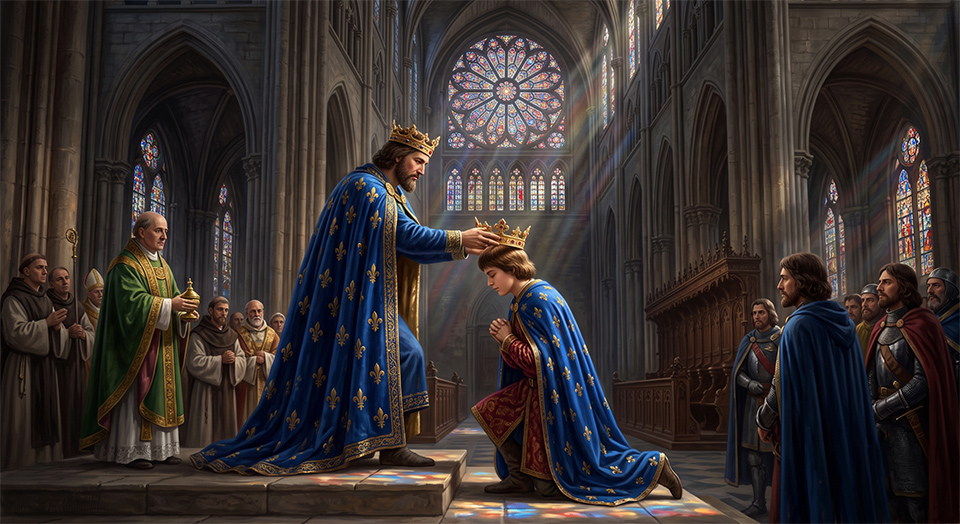
1. 987: The accession of Hugh Capet and the end of instability
At the end of the tenth century, royal power was wavering. The Carolingian dynasty, descended from Charlemagne, was weakened by the Viking invasions and the rise of the great feudal lords. In 987, on the death of Louis V, who left no heir, the nobles of the kingdom elected one of their own: Hugues Capet.
Unlike his predecessors, Hugh Capet controlled only a small royal estate located between Paris and Orléans. His power is contested. However, it was he who established the legitimacy of what would become the longest royal dynasty in Europe. His first stroke of strategic genius? Immediately associate his eldest son, Robert the Pious, with the throne.
2. The "Early Coronation": A formidable political strategy
The true "Capetian Miracle" does not lie solely in the exceptional luck of systematically having a male heir (although this played a crucial biological role). It lies in a clever political practice: the coronation of the son during the father's lifetime.
To prevent the lords from electing another king on his death, Hugh Capet had his son crowned only a few months after his own coronation. For nearly two centuries, the Capetian kings repeated this tradition. The throne is therefore never vacant. The French monarchy, which was elective (the king was chosen by his peers), once again became hereditary and indisputable in practice. The famous phrase would take on its full meaning later: "The king is dead, long live the king!".
3. From Philip Augustus to Saint Louis: The Apogee of the Direct Capetians
Thanks to this dynastic stability of more than 300 years, the Capetians were able to build France over the long term:
-
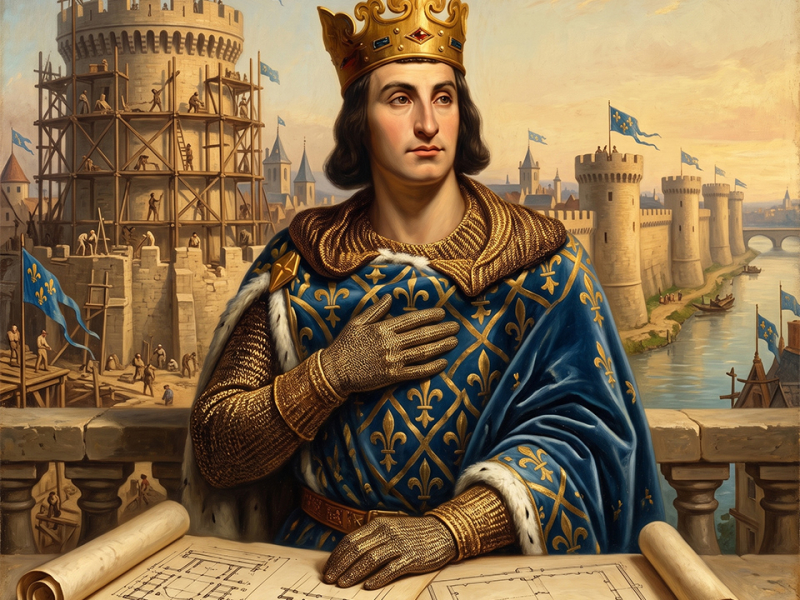
Philip Augustus (1180-1223): He was the first to be called "King of France" and no longer "King of the Franks". He quadrupled the royal domain, paved Paris, built the Louvre and defeated the English at Bouvines.
-
Louis IX, known as Saint Louis (1226-1270): A legendary figure, he pacified the kingdom, reformed the justice system and gave the crown of France immense moral and religious prestige throughout Europe.
-
Philip IV the Fair (1285-1314): He modernized the state, centralized the administration and imposed himself on the Pope.
4. 1316: The End of an Era and the Succession Crisis
But miracles must come to an end. In 1314, Philip the Fair died, leaving three robust sons. The dynasty seemed assured. However, tragedy befalls the family (the famous legend of the "Cursed Kings").
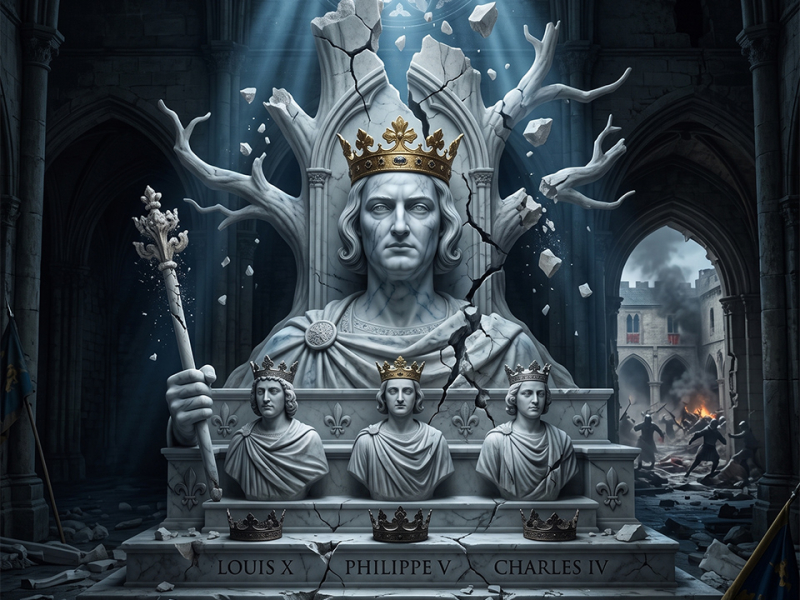
Within 14 years, Louis X, Philip V, and Charles IV died in turn without leaving a viable male heir. The last hope, John I the Posthumous, died five days after his birth in 1316. It is an absolute constitutional shock. To prevent the crown from falling into the hands of the King of England, French jurists exhumed the Salic law to exclude women from the succession. The crown then passed to the cousin branch: the Valois dynasty.
How to find one's way around and read the family tree of these dynasties?
Faced with this incredible fresco of more than 300 years of history, how do you find your way through the alliances, betrayals and changes of royal branches? How can we visualize the passage from the direct Capetians to the Valois, then to the Bourbons?
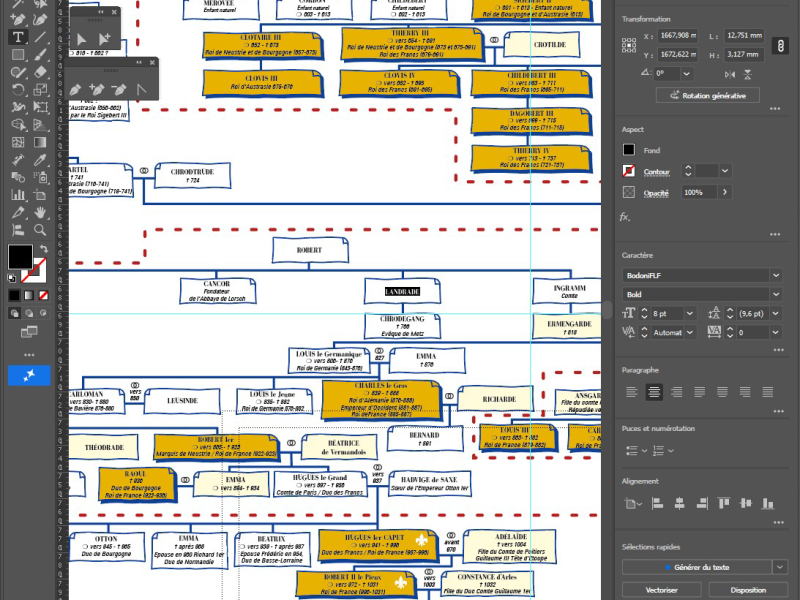
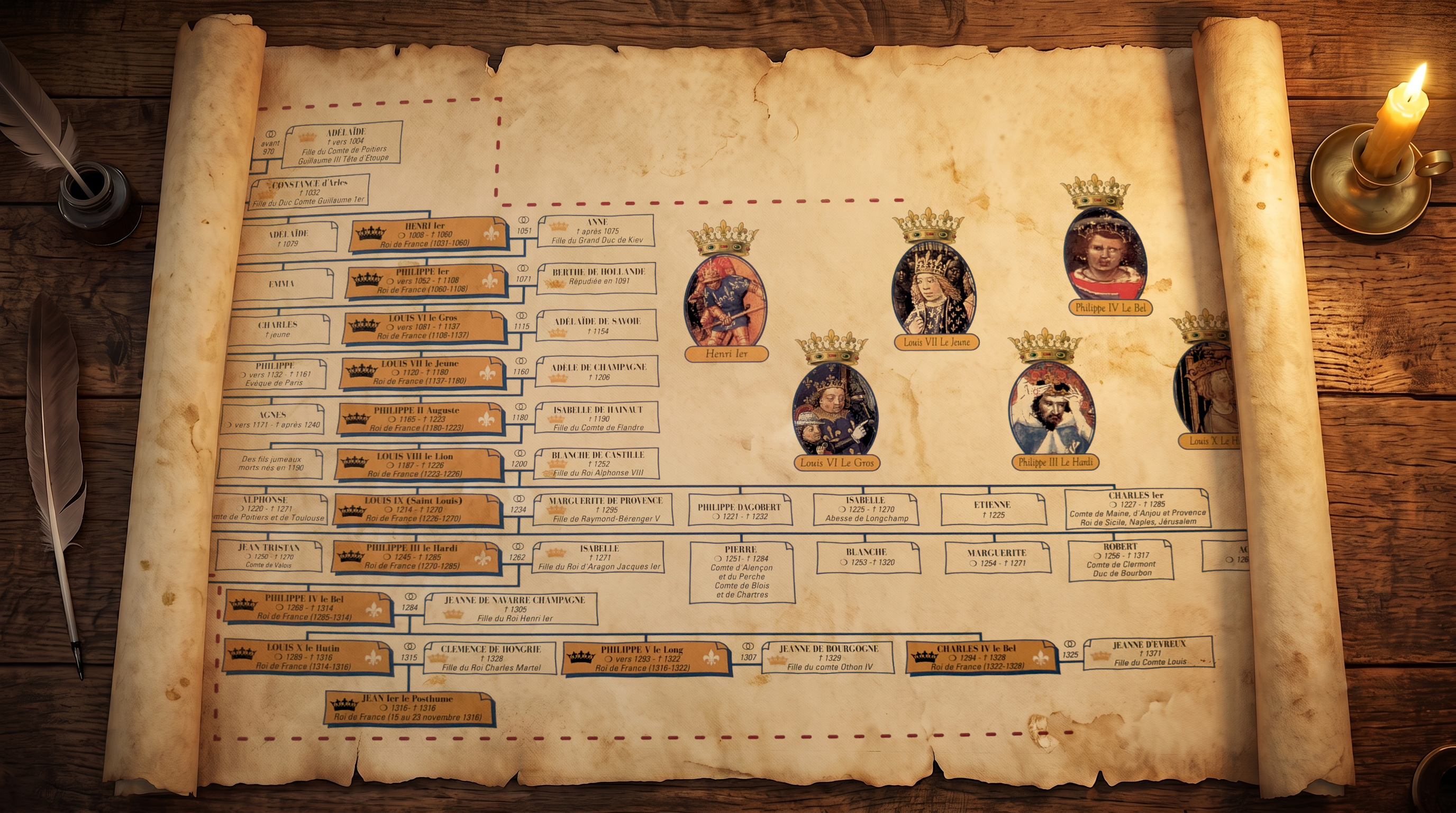
It is to meet this challenge that DYNASTIE has designed the complete genealogy of the Kings of France. This unique poster, the result of meticulous research and certified by historians, allows you to trace with one finger the uninterrupted line of this Capetian Miracle.
To read our family tree on this period:
-
Locate the central trunk: It marks the direct filiation from father to son from Hugh Capet to Charles IV the Fair. You will notice that there is no visual break.
-
Follow the color codes: They make it possible to identify the great houses. Observe the chromatic transition at the level of 1328 when the Valois branch takes over.
-
Analyze marriages (linking traits): Notice how strategic marriages (such as that of Philip Augustus with Isabella of Hainaut) made it possible to peacefully recover vast territories.
More than just a timeline, this poster is an invitation to travel back in time. By displaying it in your home, you not only have a beautiful decorative object with a 100% French design, but above all the key to understanding how a family has built, generation after generation, the country we know today.

Share this content