The Titanic Challenge of Drawing 4 Great Dynasties on a Single Poster
- 1. The Dawn of Royalty: The Merovingians (481 - 751)
- 2. Empire and Unity: The Carolingians (751 - 987)
- 3. The "Capetian Miracle" and Stability (987 - 1328)
- 4. Crises, Renaissance and Absolutism: Valois and Bourbons (1328 - 1848)
- Behind the Scenes: Structuring the Chaos of History
- How to read and understand the family tree of the Kings on our poster?

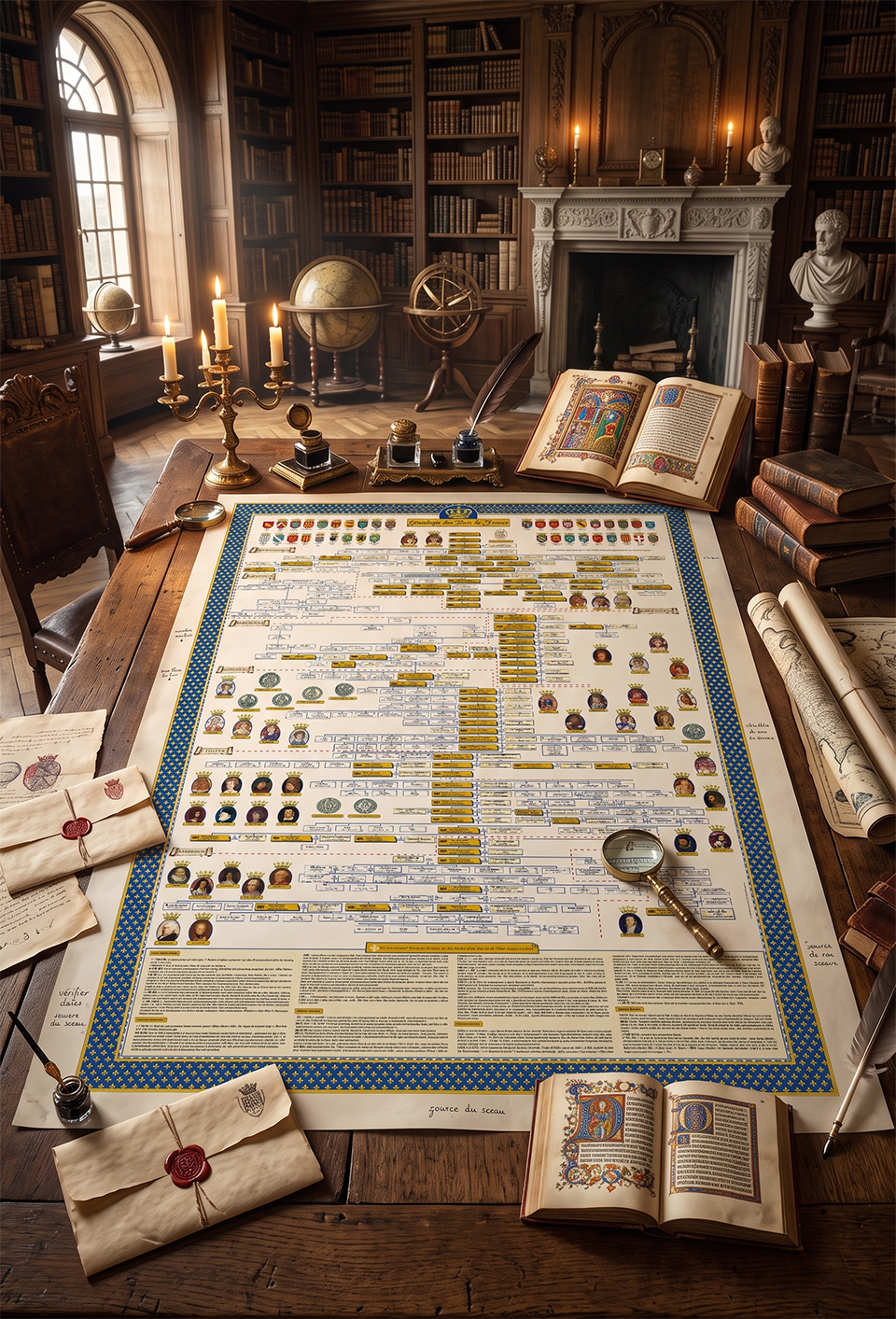
To dive into the history of France is to explore the fascinating destiny of its great dynasties. From the first Frankish kings to the twilight of the monarchy in the nineteenth century, these rulers forged the country's identity, borders and culture . But a major challenge arises when it comes to illustrating this continuity: how to fit 1300 years of history and four mythical lineages (Merovingians, Carolingians, Capetians, as well as the Valois and Bourbon branches) on a single poster ? Mission impossible? 🤯
However, this is the crazy bet we made at DYNASTIE. In this article, discover the behind-the-scenes of the creation of this monumental family tree and relive the epic of these families who built France.
1. The Dawn of Royalty: The Merovingians (481 - 751)
The genesis of our poster begins with the Merovingians. This first great dynasty laid the territorial foundations of what would become France. Representing this period on the poster requires illustrating often complex successions, marked by the Frankish tradition of dividing the kingdom between the king's sons at his death. It was necessary to draw the tortuous lines of these kingdoms (Neustria, Austrasia, Burgundy) which separated and reunited according to conquests and fratricides, from Clovis to the famous "Lazy Kings".
2. Empire and Unity: The Carolingians (751 - 987)
When Pepin the Short deposed the last Merovingian king, a new branch emerged: the Carolingians. The major graphic difficulty of this section was to integrate the colossal imperial dimension of Charlemagne, whose empire extended over a large part of Western Europe. The tree here is intended to show how, after the Treaty of Verdun in 843, the branch of West Francia (our future France) broke away to form a distinct lineage, fighting against Viking invasions and the rise of the local aristocracy.

3. The "Capetian Miracle" and Stability (987 - 1328)
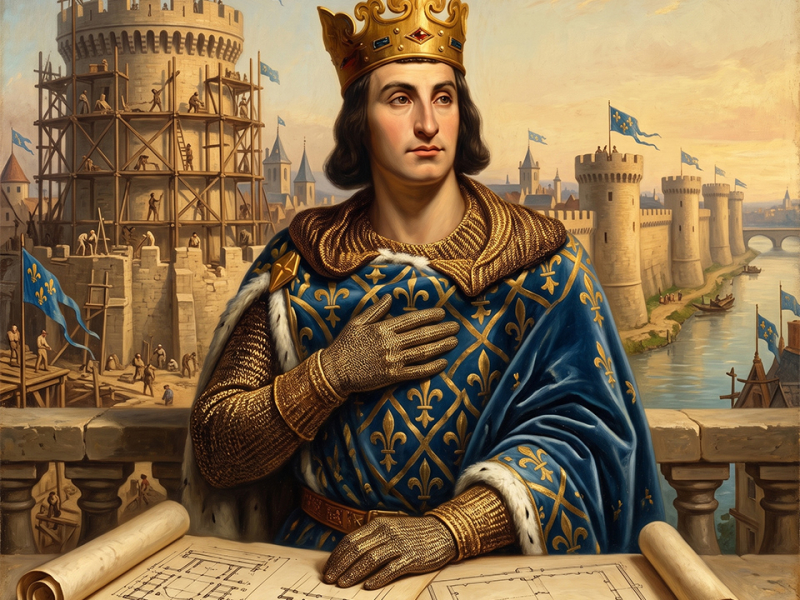
The election of Hugh Capet in 987 marked a turning point. Graphically, this section of our tree is the most linear. This is what historians call the "Capetian miracle": for more than three centuries, from father to son, the direct Capetians passed on the crown to each other without interruption. On our poster, this period is represented by a strong and majestic central trunk, symbolizing the consolidation of royal power, the centralization of the State under Philippe Auguste, and the cultural influence under Saint Louis.
4. Crises, Renaissance and Absolutism: Valois and Bourbons (1328 - 1848)
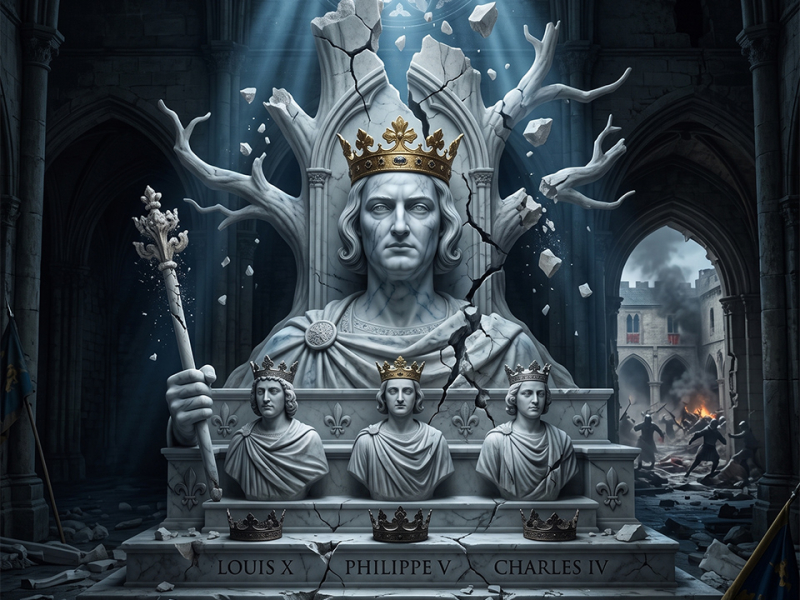
This is where the tree branches out spectacularly. In 1328, the death without a male heir of Charles IV the Fair broke the direct line. The throne passed to the Valois, triggering the Hundred Years' War. Our tree accurately maps these dynastic bifurcations, including the cadet branches (Valois-Orléans, Valois-Angoulême).
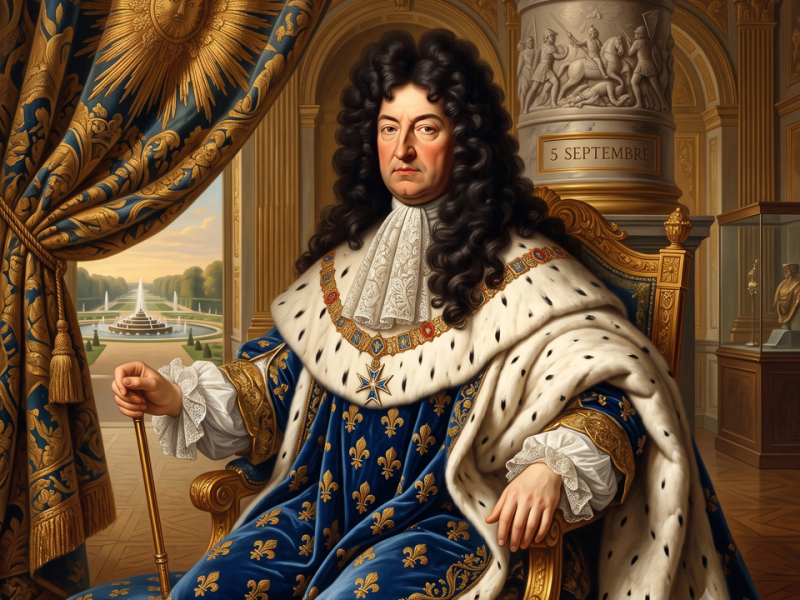
Then came the assassination of Henry III in 1589, which gave way to the Bourbon dynasty with Henry IV. On the poster, the apogee of this branch is illustrated by the reign of Louis XIV, the Sun King, before withering away through the tumults of the French Revolution, to end with the final jolts of the Restoration and the July Monarchy (the Orléans branch).
Behind the Scenes: Structuring the Chaos of History
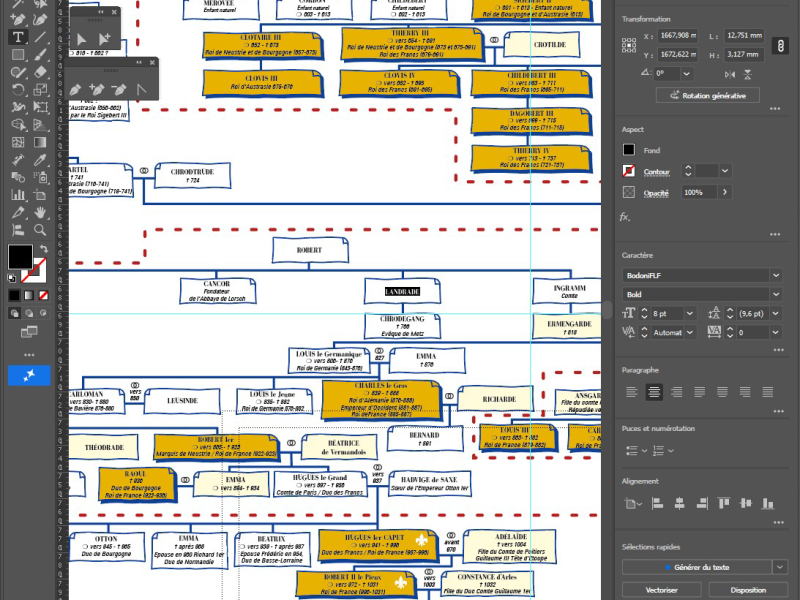
Look at how the family tree has been structured! The goal of DYNASTY was not only to list names, but to make intelligible a network of alliances, strategic marriages, and wars of succession. We have worked with historians to ensure that every ramification is accurate. The challenge was to find the perfect balance between historical comprehensiveness (leaving no king out) and a clean, elegant design that fits into a modern living room.
How to read and understand the family tree of the Kings on our poster?
To make this document both a work of art and an educational guide that brings real value to the reader, here is the infallible method to decipher it:
-
The vertical chronology: The poster can be read from top to bottom. The more visually you descend on the poster, the more you advance in time, from the Merovingians (top) to the last Bourbon and Orléans kings (bottom).
-
The branching system: The main and thick line represents the reigning sovereign. When a line branches off to the side, it signals a change in dynastic branch (for example, the transition from the direct Valois to the Valois-Orléans).
-
Symbolism and colours: To make it easy for you to find your way around, the 4 great dynasties are associated with subtle graphic and colorimetric references. So, at a glance, you can spot the end of one era and the beginning of another.
-
Key information: Under each monarch's name, his reign dates are inscribed. The most important unions – those that have redrawn the borders of France – are materialized by specific junctions.
It is to meet this challenge that DYNASTIE has designed the complete genealogy of the Kings of France. Tell us in the comments: among all these great families, which dynasty do you prefer! 👇
Share this content